
The Art of the "Reverse Grade Calculation": How to Plan Your Way to a Target GPA
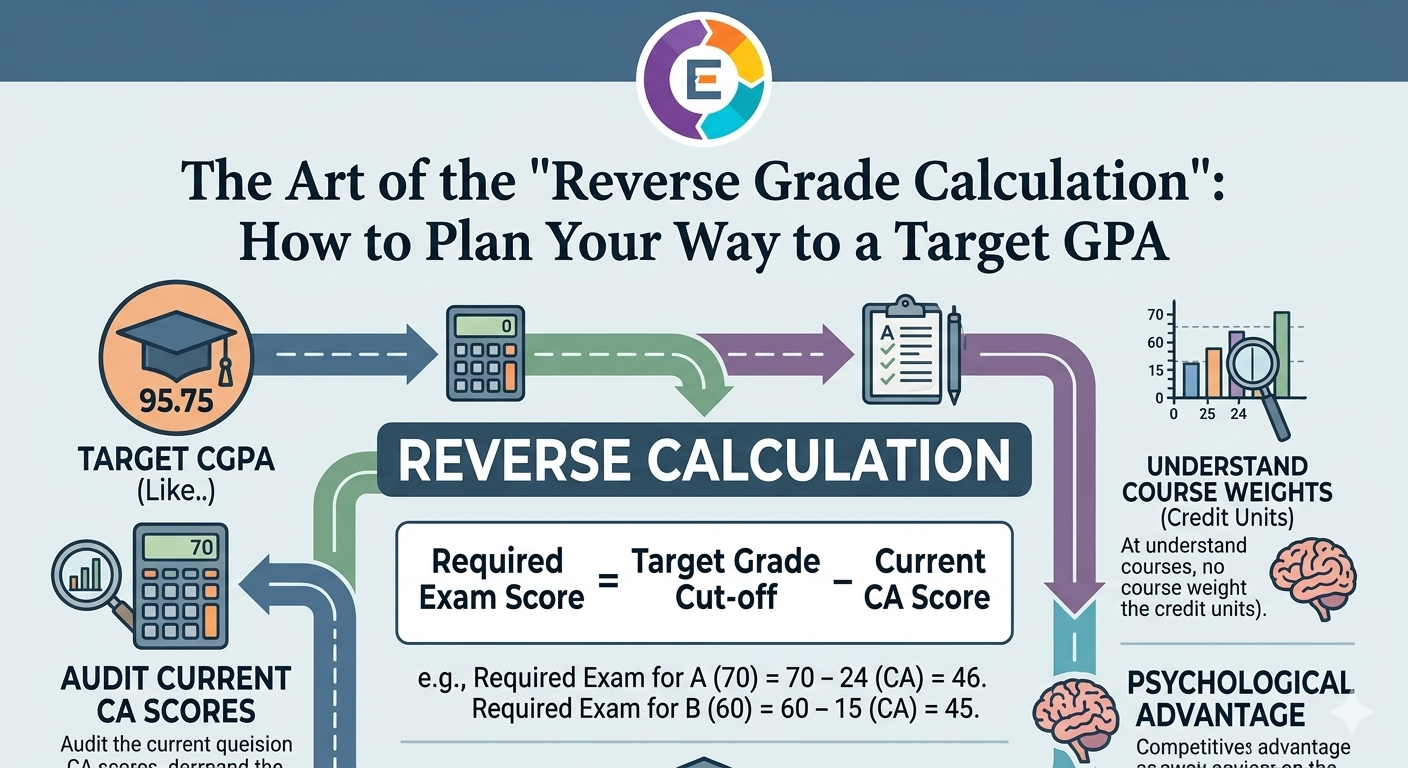
Most students approach their grades entirely backwards. They attend lectures, sit for exams, wait for the semester results to drop, and then look at their updated Cumulative Grade Point Average (CGPA) with either a sigh of relief or a knot of regret. This is passive academic tracking.
Top-performing students use a completely different framework: Reverse Grade Calculation. Instead of waiting to see what GPA they get, they calculate exactly what grades they need before they ever step into the exam hall. Whether you are a 100-level student trying to build an iron-clad foundation, a student trying to keep a first-class GPA on track, or someone trying to rescue a slipping score, mastering this mathematical strategy takes the anxiety out of finals week and replaces it with a clear, actionable roadmap.
1. What is Reverse Grade Calculation?
In simple terms, reverse grade calculation is working backwards from your desired end-of-semester goal to determine your required inputs.
Instead of asking, "What will my CGPA be if I get a B in this 3-unit course?" you ask, "To finish this semester with a 4.50 GPA, what is the absolute lowest grade I can afford to get in this 3-unit course?"
By calculating this beforehand, you remove blind spots. You stop wasting sleepless nights over-studying for a course where you already have an unshakeable A, and you start redirecting your energy toward the high-credit-unit courses that will actually move the needle.
2. Understanding Your System's Leverage (Credit Units)
You cannot reverse-calculate your grades without understanding that not all courses are created equal. The weight of a course is determined by its credit units (or credit hours).
A 3-unit or 4-unit course acts like a heavy anchor. An A in a 4-unit course will pull your GPA up drastically, while an F in that same course will drag it down like a stone. Conversely, a 1-unit practical or elective course has very little leverage.
The Strategy: If you are running short on time during exam prep, prioritize your study schedule based on credit unit weight. Getting an A in a 3-unit course and a C in a 1-unit course yields a far higher GPA than getting a C in the 3-unit course and an A in the 1-unit course.
3. The Step-by-Step Reverse Math
To figure out your target exam scores, you need to look at how your current Continuous Assessment (CA) scores pair with your final goals.
Step A: Audit Your Continuous Assessment (CA)
Most academic grading scales are split between continuous assessments (tests, quizzes, attendance, labs) and the final examination. Typical Scale: 30 or 40 Marks for CA + 60 or 70 Marks for the Exam = 100 Total Marks.
Before exams start, log into your student portal or check your department notice boards to collect your raw CA scores out of 30 or 40.
Step B: Identify the Target Thresholds
Look at your institution's official grading scale to find the minimum cut-off marks for each grade letter. For example, on a standard 5.0 grading scale:
- A = 70 marks and above
- B = 60 to 69 marks
- C = 50 to 59 marks
Step C: Apply the Reverse Formula
The basic equation to find your required exam score is straightforward:
$$\text{Required Exam Score} = \text{Grade Threshold} - \text{Your Raw CA Score}$$
A Real-World Example: Imagine you are taking a heavy 3-unit core engineering or science course. Your CA test scores total 24 out of 40. You want to secure an A in this course to maintain your target GPA. The threshold for an A is 70 marks.
Apply the math: $70 - 24 = 46$. The result: you need to score a minimum of 46 out of 60 on the final examination to get your A.
What if your CA score was lower, say 15 out of 40, and you just want to secure a strong B (60 marks) to rescue the course? Apply the math: $60 - 15 = 45$. The result: you need a 45 out of 60 on the final exam just to pull off a B.
4. How to Apply This to Your Cumulative GPA (CGPA)
If you want to calculate how this semester's targets affect your overall lifetime CGPA, the process scales up slightly.
- Find your current totals: multiply your current CGPA by your total accumulated credit units up to your last semester. This gives you your total quality points.
- Project your goal: decide what you want your new CGPA to be at the end of this semester and multiply that target number by your new cumulative total units (past units + this semester's current units).
- Find the difference: subtract your old quality points from your target quality points. The result is exactly how many quality points you must earn this semester to hit your goal.
Tech Tip for Your Website Readers: If doing this multi-semester algebra by hand makes your head spin, stop relying on scratch paper. Use a dedicated, custom-built CGPA Calculator supporting your school's specific scale (whether it is a 4.0, 5.0, or 7.0 system). A smart calculator lets you plug in your current standing, input your estimated target grades for the week, and instantly displays your projected outcome.
5. The Psychological Advantage of Knowing Your Numbers
Aside from the pure mathematics, reverse grade calculation provides a massive psychological edge when walking into a high-pressure exam hall:
- It eradicates the "Perfection Trap": Many students panic because they think they need to score 100% on every paper. When you realize that a 48 out of 70 on an exam gives you the exact same A as a 70 out of 70, the pressure drops instantly.
- It clarifies low-risk vs high-risk situations: If your reverse calculation reveals that you only need a 25 out of 60 on an exam to pass a low-leverage elective, you can confidently skim that material and dedicate your core focus to the brutal technical exams where your margins are razor-thin.
- It fuels motivation: It is much easier to study intensely when you have a highly specific target, like "I just need 52 marks on this paper to protect my first-class status," rather than a vague, overwhelming goal like "I need to do well."
Final Word
Don't let your grades happen to you by accident. Treat your academic semester like a project manager treats a deadline: break down the weights, audit your current progress, calculate your required exam inputs, and execute with absolute mathematical precision.
Return to Home or Contact Us for tailored grade-planning support.