
Mastering High-Stakes Entrance Exams: A Blueprint for Balancing Multiple Terminal Papers Simultaneously
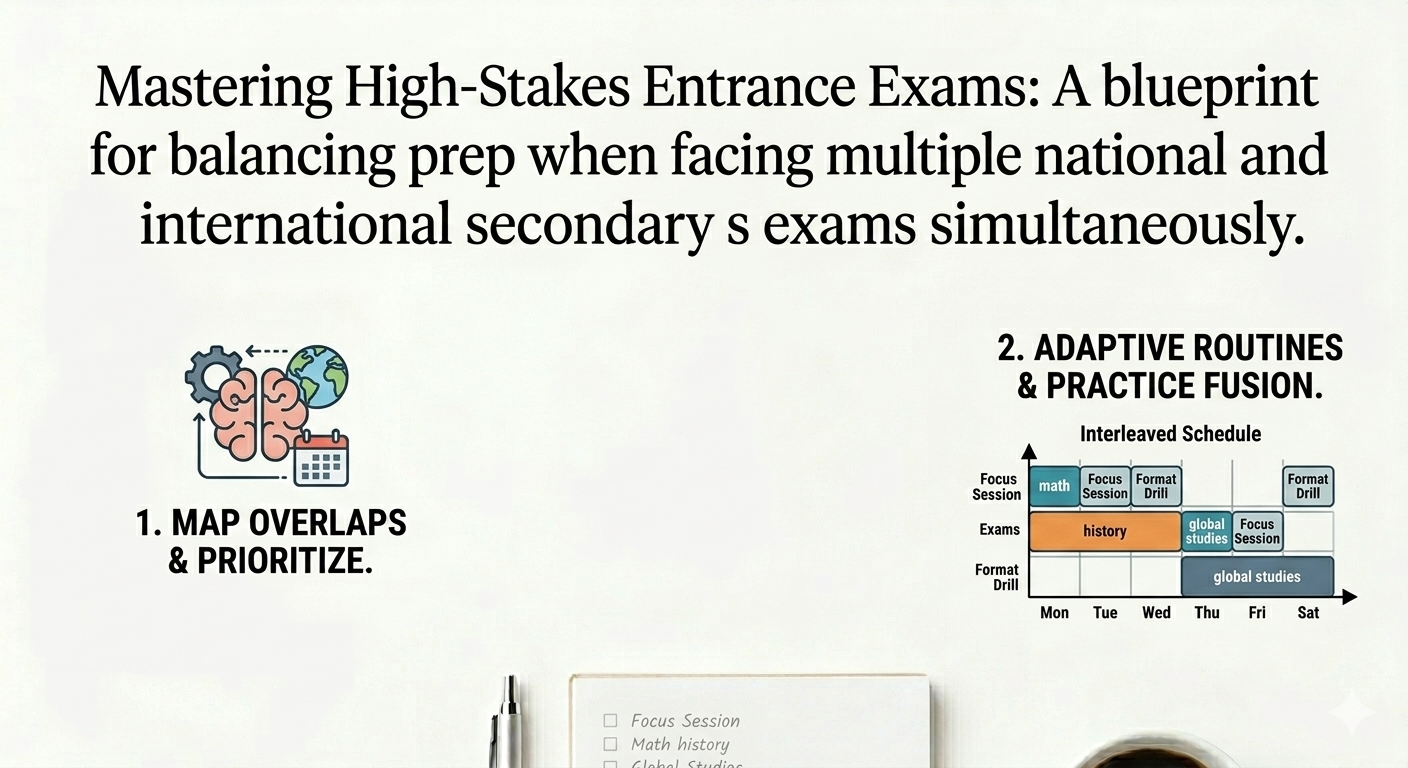
There is a specific kind of panic that sets in during the final year of secondary school. It is the realization that your entire academic future isn't riding on just one final paper, but rather a chaotic collision of multiple national and international exams all stacked within the same few months.
In West Africa, for example, a high-achieving student might find themselves juggling the West African Senior School Certificate Examination (WASSCE/WAEC), national university entry exams like the Joint Admissions and Matriculation Board (JAMB) Unified Tertiary Matriculation Examination (UTME), university-specific Post-UTME screening tests, and international standards like the SAT or Cambridge GCE A-Levels.
When you are facing this mountain of assessment papers simultaneously, standard study advice falls flat. You cannot simply "study harder." If you try to give 100% of your energy to everything at once, you burn out before the first exam even begins. Survival and success require a deliberate, strategic blueprint.
1. Map the Overlap: The Core Syllabus Hack
The biggest mistake students make is treating every exam as a completely separate island. They buy a JAMB prep book, a WAEC syllabus, and an SAT study guide, and try to read them all independently.
In reality, the laws of physics, mathematics, and grammar do not change depending on the logo at the top of your exam sheet.
The Strategy: Sit down with the syllabi for your exams and find the common denominators.
- The Overlap: If you are studying Calculus or Organic Chemistry for an advanced secondary school exam, you are simultaneously covering the theoretical foundations needed for the computational questions in JAMB or Post-UTME.
- The Workflow: Spend 70% of your study time mastering these overlapping foundational concepts. Once the core concept is locked into your long-term memory, spend the remaining 30% adapting that knowledge to the specific format of each individual exam.
2. Decode the Exam Formats (Theory vs. Speed)
While the core knowledge overlaps, the way you are tested varies drastically. You must train your brain to adapt to the specific psychological demands of each test type.
| Exam Type | Core Demand | Tactical Focus |
|---|---|---|
| Syllabus-Based / Theory | Depth & Structure | Practice manual calculations, speed-writing, and memorizing official marking scheme keywords. |
| Speed / Computer-Based (CBT) | Pacing & Precision | Master elimination strategies, digital pacing checkpoints, and time-saving mental math approximations. |
| Aptitude / Critical Thinking | Logic & Context | Learn to recognize question patterns, trap answers, and time-saving reading shortcuts. |
3. Implement the "Focus Pivot" Scheduling Model
Trying to study for JAMB on Monday morning, WAEC on Monday afternoon, and the SAT on Monday night creates intense cognitive friction. Your brain wastes too much energy switching modes. Instead, use a Focus Pivot schedule based on your exam calendar timeline.
Phase 1: The Macro-Layer (2–3 Months Out)
Focus heavily on deep conceptual understanding and the most comprehensive, text-heavy exams. Building deep theoretical knowledge here creates a massive safety net for your other exams.
Phase 2: The Micro-Pivot (3–4 Weeks Out)
As a specific exam date approaches, pivot your schedule to prioritize that format. If your CBT is three weeks away, shift 80% of your prep to high-speed, timed multiple-choice practice. Once that exam concludes, instantly pivot your daily routine to the next target.
4. The Past Paper Simulation Method
The closest thing to a magic bullet for high-stakes exams is the relentless, disciplined use of past questions. However, looking at a past question and casually flipping to the back is an illusion of studying.
- Replicate the Constraints: If a past JAMB paper gives you 2 hours for 180 questions, clear your desk, set a strict alarm for 2 hours, unplug your internet connection, and do the entire paper in one sitting.
- The Error Audit: Go through every question you got wrong or guessed correctly by luck. Write down why you missed it so you can fix the exact vulnerability before test day.
5. Protecting Your Cognitive Engine
When balancing a multi-exam load, your brain is under immense neurological strain. Mental exhaustion directly degrades reading comprehension, working memory, and emotional stability during exams.
Sleep is Part of the Syllabus: Sleep is not a reward for studying; it is a fundamental step in the learning process. Your brain solidifies short-term exam data into long-term memory primarily during deep sleep cycles.
Embrace the Journey: Remind yourself that thousands of successful university students stood exactly where you are standing right now. This intense period of academic pressure is finite.
Summary for the Smart Candidate
Do not panic at the sheer volume of registration slips on your desk. Strip away the intimidating brand names of the exams and look at the underlying science and arts. Organize your calendar around format pivots, capitalize heavily on syllabus overlaps, use past papers like a scientist, and trust the work you have put in. Your spot in the university lecture hall is waiting on the other side.
Return to Home or Contact Us for more study support.