
Beyond Cramming: Active Recall and Spaced Repetition Study Methods That Actually Lock Information Into Your Long-Term Memory
We have all been there: you spend eight straight hours staring at a textbook or highlighting pages of lecture slides the night before a massive exam. You walk into the test hall feeling full of information, only for your mind to go completely blank the moment you read Question 1.
The culprit isn’t your intelligence—it is cramming. Cramming relies on passive review, and passive review creates a dangerous cognitive illusion known as the fluency heuristic. Because information looks familiar, your brain tricks you into believing you have memorized it. In reality, you have not built the neural pathways required to pull that information out under pressure.
If you want to ace complex technical courses, high-stakes university exams, or standardized tests, you need to transition from passive review to two evidence-based cognitive-science superpowers: Active Recall and Spaced Repetition.
1. Active Recall: The Power of Forcing Your Brain to Work
Most students study by trying to push information into their brains. Active recall turns this upside down by forcing your brain to pull information out.
Every time your brain undergoes the uncomfortable effort of retrieving a fact without looking at the answer, it strengthens the neural pathways connected to that memory. Think of it like lifting weights: rereading your notes is like watching someone else lift weights; active recall is doing the heavy lifting yourself.
How to Implement Active Recall
- The Feynman Technique: After reading a complex chapter, close the book and explain the concept from scratch as if teaching a 10-year-old. Patch the gaps you cannot explain and repeat.
- The Toggle Method: Turn slide notes into questions. Hide the answer and force yourself to answer before revealing it.
- The Closed-Book Brain Dump: Read for 15 minutes, then close the book and write down everything you remember. Use a different colored ink to correct and add what you missed.
2. Spaced Repetition: Beating the "Forgetting Curve"
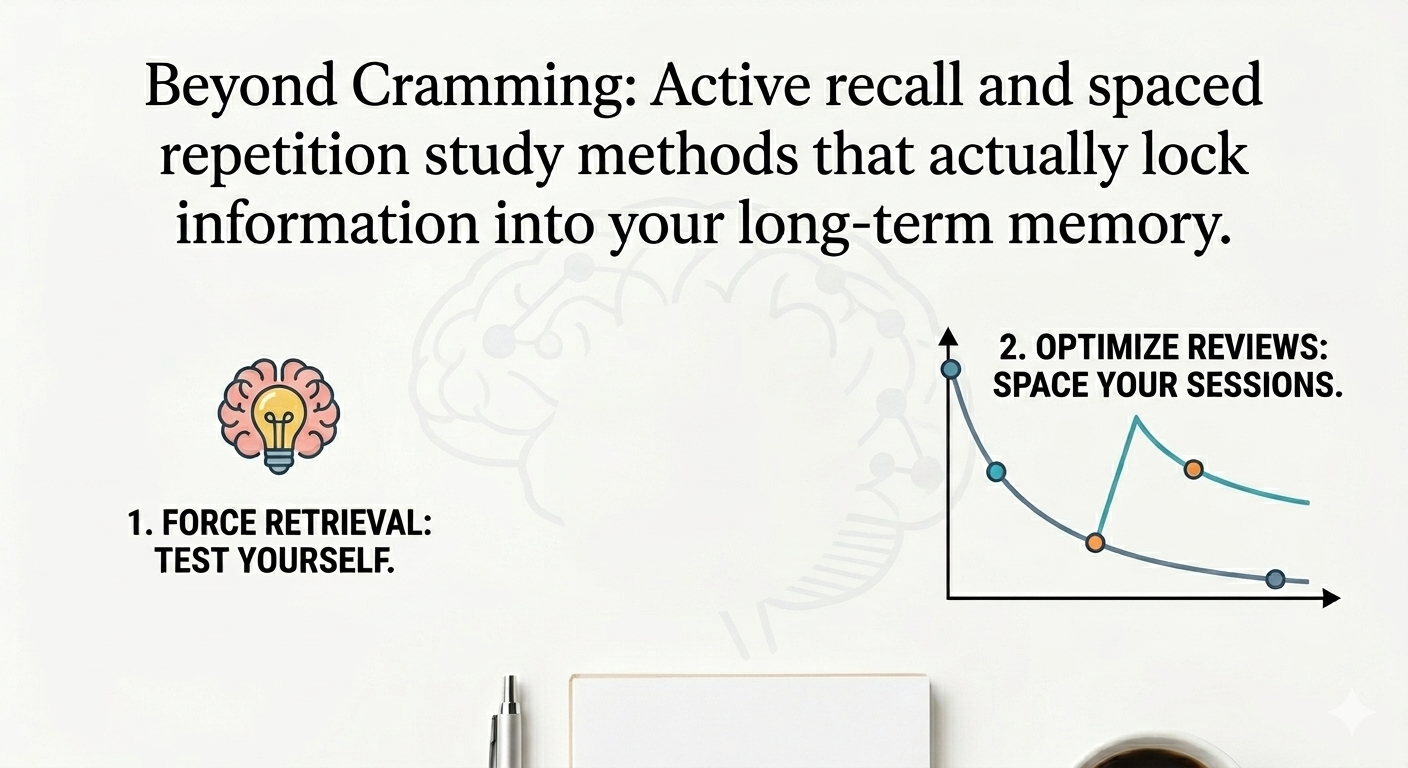
Psychologist Hermann Ebbinghaus discovered that humans lose a large portion of new information within 24 to 48 hours unless it is actively reinforced.
Spaced repetition hacks the curve by reviewing material at the moment you are about to forget it. Each review flattens the curve and pushes information deeper into long-term memory.
The Optimal Spaced Repetition Schedule
- Review 1: 24 hours after the initial lecture.
- Review 2: 3 days later.
- Review 3: 7 days later.
- Review 4: 14 days later.
- Review 5: 30 days later, right before exams.
3. Merging the Two: The Ultimate Long-Term Memory Toolkit
When you combine active retrieval with well-timed spaced intervals, your exam preparation transforms. You will walk into tests with far less frantic, last-minute energy because the concepts are already rooted deeply.
Option A: The Digital Flashcard Route
Anki and RemNote are widely used because they automate the spaced repetition math. You create a card with an active recall question on the front and the answer on the back, then grade how difficult it was to remember. Easy cards come back later; difficult cards return sooner.
Option B: The Analog Leitner Box System
If you prefer physical study tools, use the Leitner Box System. Put all cards in Box 1, review them daily, and move cards up as you get them right. Wrong cards drop back to Box 1. Your goal is to get every card to Box 5 by exam week.
4. Why This Feels Harder (And Why That Is Good)
Active recall and spaced repetition feel difficult because they require real cognitive effort. Psychologists call this a desirable difficulty. The friction you feel is the exact mechanism that tells you real learning is occurring.
Final Takeaway
Stop treating your brain like a storage box that you can stuff 24 hours before a paper. Treat it like a muscle. Apply active recall to force retrieval, scale it across time using spaced repetition, and watch your exam anxiety fade as your grades steadily climb.
Return to Home or Contact Us for more study support.